
From Ambulance to Airlift: Ensuring Medical Device Performance in Emergency Care

22 Jun 2026
Designing for Motion, Shock, and Continuous Uncertainty in Emergency Medical Services (EMS) Environments
Medical devices intended for Emergency Medical Services (EMS) operate in environments far different from controlled clinical settings. Ground/water ambulances, helicopters, and field response units expose equipment to continuous vibration, mechanical shock, unstable vehicle power, fluctuating environmental conditions, and high electromagnetic activity. IEC 60601-1-12 was developed to address these realities. As a collateral standard to IEC 60601-1, it establishes additional safety and essential performance requirements for medical electrical (ME) equipment and ME systems intended specifically for EMS deployment. For manufacturers claiming ambulance or field suitability, compliance demonstrates that devices are engineered for mission-critical reliability when patients are most vulnerable.
EMS environments include ground ambulances, rotorcraft, fixed-wing air ambulances, and outdoor emergency response settings. Unlike hospitals, these settings introduce dynamic stresses that are continuous and unpredictable. Equipment must perform under vehicle acceleration and braking, road-induced vibration, turbulence, electrical transients, temperature swings, condensation, and high ambient noise. IEC 60601-1-12 translates these challenges into measurable design and verification requirements, ensuring devices maintain essential performance under real-world conditions.
Mechanical integrity is a core focus. EMS devices are not stationary assets; they are transported over uneven roads, secured inside aircraft, carried to and from emergency scenes, and mounted on stretchers or wall brackets. In this environment, equipment can be bumped, jostled, or inadvertently dropped. The standard requires manufacturers to validate performance under representative transport conditions, including multi-axis vibration testing, mechanical shock evaluation, handling and drop resilience, and secure mounting verification. Devices must not only survive these stresses but maintain essential performance throughout exposure.
Electrical robustness is equally critical. Unlike hospital power, EMS vehicles rely on 12V or 24V DC systems, alternator-based charging, inverters, and internal batteries, all of which can be prone to voltage fluctuations, power interruptions, and transients. IEC 60601-1-12 ensures that equipment tolerates these disturbances without compromising safety or essential functions. Seamless transfer between vehicle power and internal batteries is mandatory for life-sustaining devices, making electrical stability a foundational requirement for uninterrupted therapy.
EMS deployment also exposes devices to environmental extremes rarely seen in hospitals. Temperature swings, high humidity, condensation, dust, and splash exposure can all affect electronics, batteries, displays, seals, and mechanical components. The standard requires manufacturers to define, test, and document operating limits and, where applicable, validate ingress protection (IP) ratings. Clear labeling ensures that end users understand environmental constraints, guaranteeing reliable performance in field conditions.
Electromagnetic compatibility (EMC) is another essential consideration. EMS vehicles are dense RF environments, with two-way radios, cellular transmitters, dispatch systems, and navigation equipment. IEC 60601-1-12, working alongside IEC 60601-1-2, ensures devices maintain essential performance under elevated RF exposure, resist conducted disturbances, and do not introduce unacceptable interference. EMC testing must reflect real-world operational conditions rather than baseline laboratory assumptions.
Risk management under ISO 14971 must account for EMS-specific hazards, including therapy interruption due to vibration, unintended disconnection, battery depletion, alarm audibility in noisy environments, and mechanical detachment during sudden deceleration. Essential performance must be preserved during these foreseeable stresses, not just in laboratory conditions. Verification and validation must demonstrate that clinically critical functions remain operational throughout EMS deployment, protecting patient safety in pre-hospital care.
IEC 60601-1-12 bridges the gap between hospital-based safety standards and the realities of mobile emergency care. Compliance ensures that devices withstand transport stresses, remain electrically stable under variable vehicle power, resist environmental extremes, and maintain essential performance in unpredictable settings. For manufacturers, adherence goes beyond regulatory requirements it signals a commitment to reliable performance when seconds matter, building confidence among clinicians, system integrators, and patients that equipment will perform under the most challenging pre-hospital conditions.

You may be interested in...
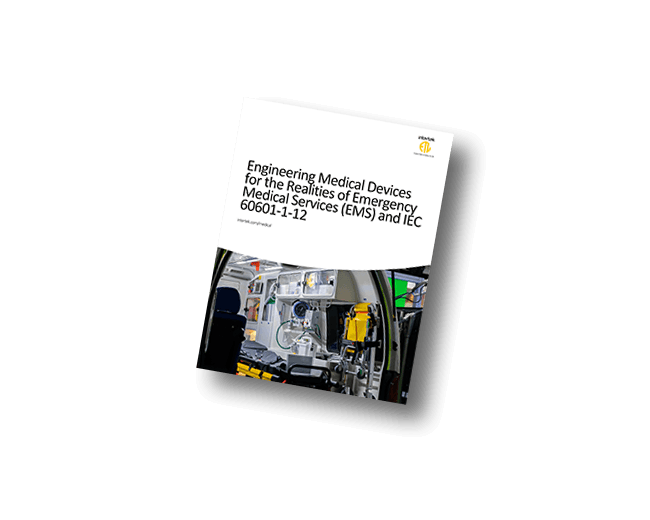
Designing Medical Devices for Real-World EMS Conditions | White Paper
Medical devices used in Emergency Medical Services face extreme conditions far beyond the hospital. This white paper explores how IEC 60601-1-12 and IEC 60601-1-2 requirements help manufacturers design for vibration, power instability, environmental stress, and high RF exposure to ensure essential performance when it matters most.

Visit our Medical Resources Hub and stay up to date with industry trends, changing standards and market opportunities with white papers, on-demand webinars, FAQs, and fact sheets.