
A comprehensive, standards-driven approach to identifying, evaluating, and mitigating risks—ensuring safer products, streamlined compliance, and faster market readiness.
Intertek specializes in helping organizations navigate the complexities of product safety, compliance, and risk management. Our risk assessment services provide a structured, standards-based approach to identifying potential hazards, evaluating risks, and implementing effective mitigation strategies. The result: safer products, streamlined compliance, and greater confidence in your products and processes. Let us remove the guess work and simplify the RA process.
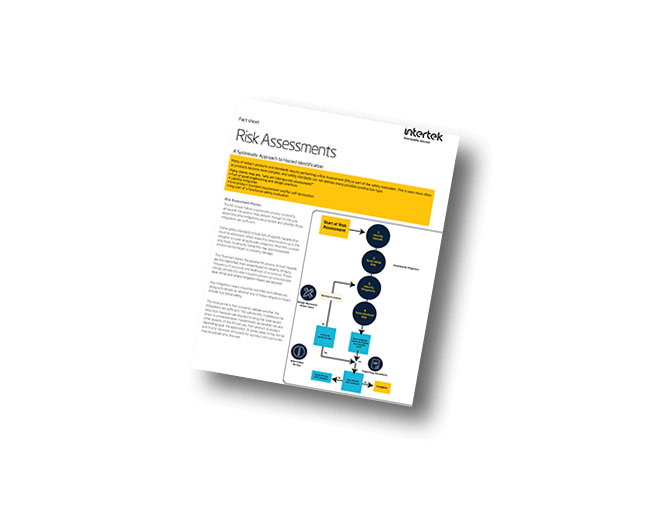
Risk Assessments are essential for identifying hazards, ranking risks, and applying mitigation measures to ensure safe, compliant environments. Download our fact sheet and learn more.
What is Risk Assessment?
A risk assessment is a structured process used to identify potential hazards, evaluate their likelihood and severity, and determine whether risk reduction measures are needed. It helps ensure products, systems, or processes are safe, compliant, and ready for market.
Why Risk Assessment Matters?
A robust risk assessment not only safeguards your customers and their workforce but also protects your brand, reduces liability, and accelerates time to market. With regulators and certifying bodies demanding rigorous safety evidence, having a trusted partner ensures that nothing is overlooked. Risk Assessments are required by Machinery, Robotics and many other product standards.
Our Expertise
We tailor every engagement to your industry and application, leveraging internationally recognized standards. Some common Risk Assessment standards that we cover:
- ISO 12100 – Risk assessment & reduction for machinery
Defines a systematic process to identify hazards, estimate and evaluate risks, and implement risk reduction measures throughout a machine’s lifecycle. ;Best suited for machine designers, integrators, and manufacturers seeking a foundational, lifecycle-based approach to machinery safety. - NIST SP 800-30 – Guide for Conducting Risk Assessments (Cybersecurity)
Outlines a repeatable methodology to identify threats, vulnerabilities, likelihoods, and impacts to support risk-based decision making. Useful for CISOs, risk managers, and IT/security teams across government and industry needing a practical, widely recognized risk assessment approach. - ISO 27005 – Information security risk management
Provides guidance for establishing, implementing, maintaining, and continually improving information security risk management aligned with ISO/IEC 27001. Ideal for organizations building or maintaining an ISMS, especially security leaders and compliance teams aiming to operationalize risk treatment. - ISO/IEC TS 22440-1 – Artificial Intelligence – Functional safety and AI systems
Offers technical guidance on integrating AI systems within functional safety contexts, addressing hazards, assurance, and lifecycle considerations unique to AI. Benefits safety engineers, AI developers, and system integrators who need to justify and manage AI behavior in safety-relevant applications. - IEC 62443-3-2 – Security risk assessment for industrial automation and control systems
Defines a structured process for security risk assessment and system design in IACS, including asset identification, threat modeling, and risk treatment. Targeted to OT security architects, plant engineers, and system integrators securing industrial networks and control systems. - ISO/SAE 21434 – Road vehicles - Cybersecurity engineering
Specifies cybersecurity risk management processes across the automotive product lifecycle, from concept and development to production, operation, and decommissioning. Intended for OEMs, Tier 1–N suppliers, and mobility service providers aligning with vehicle cybersecurity requirements (complementary to UNECE R155). - UL 2900-1 – Software cybersecurity for network-connectable products (Section 12)
Establishes testable cybersecurity requirements for software-driven, connected products, including vulnerability assessment and risk controls (with Section 12 focusing on risk management evidence). Valuable to product manufacturers and developers of IoT/connected devices seeking third-party certification or robust due diligence for market access. - FDA Guidance for Industry – Cybersecurity in Medical Devices: Quality System Considerations and Content of Premarket Submissions (Section V.A)
Details how to integrate secure-by-design practices into the device quality system and what cybersecurity documentation to include in premarket submissions (Section V.A outlines risk management expectations). Applies to medical device manufacturers and developers preparing 510(k), De Novo, or PMA submissions who must demonstrate effective cybersecurity risk controls. - AAMI TIR34971 – Medical devices and AI (risk management set)
Provides technical guidance for applying risk management to medical devices leveraging AI/ML, including data, model, and postmarket considerations aligned with safety and effectiveness. Best for RA/QA leaders, clinical and data science teams, and device manufacturers integrating AI who need a structured, evidence-based risk framework.
How We Support You
- Comprehensive Hazard Analysis: Identify risks early through proven methods (PHA, FMEA, HAZOP).
- Standards-Based Risk Evaluation: Benchmark risks against globally accepted tolerability criteria.
- Creation and maintenance of your Risk Management File.
- Clear Mitigation Strategies: Practical design and safety recommendations that reduce risks to acceptable levels.
- Compliance-Ready Documentation: Deliverables designed to support CE Marking, and ETL certifications.
The Intertek Advantage
- Expert Guidance: Our consultants are specialists with deep experience in functional safety and regulatory compliance.
- Tailored Solutions: We offer tailored solutions that meet the exact needs of your team.
- Faster Certification: We streamline communication with certifying bodies, reducing costly delays.
- Peace of Mind: You gain confidence knowing your systems meet safety, legal, and performance expectations.
Risk Assessment Frequently Asked Questions (FAQs)
The most effective time is early in the design phase, when safety improvements are easiest and most cost effective. However, assessments can be performed at any stage, including redesigns, retrofit projects, or post incident investigations.
Typical assessments evaluate mechanical, electrical, thermal, chemical, functional safety, and cybersecurity hazards depending on the product or system. Intertek tailors each assessment to the relevant standards and the specific risks of your technology.
You’ll receive a complete, standards aligned Risk Management File with hazard analysis, risk evaluation tables, mitigation recommendations, and compliance ready documentation. This supports CE Marking, OSHA/NRTL certifications, and industry specific submissions.
For machinery and automation equipment these standards work together to provide a framework for identifying hazards, clarify risks and provide a verifiable path for proper mitigation of these risks. ISO 12100 is the driving risk assessment standard for most machinery equipment. ISO 13840 and IEC 61508 provide a guide to developing and maintaining industry accepted hazard mitigation means.
Yes, our experts conduct assessments aligned with NIST SP 800‑30, ISO 27005, IEC 62443, ISO/SAE 21434, UL 2900-1, and FDA cybersecurity expectations. This includes reviewing threats, vulnerabilities, attack surfaces, and security controls for connected products and OT/IT systems.
Manufacturing, industrial automation, automotive, medical devices, energy, robotics, and IoT/connected products all rely on risk assessments for compliance and safe operation. Any organization building complex or software-driven systems gains value from the process.
Timelines vary based on system complexity, documentation maturity, and applicable standards. Many assessments can be completed in a couple of days to a few weeks, while highly regulated systems, such as medical devices or safety-instrumented process systems, may require longer.
Intertek Assurance provides practical mitigation strategies, design guidance, and documentation that aligns directly with certification pathways. Our Assurance team can support you from initial analysis through compliance testing, certification, and ongoing updates to your risk management file.
Yes, Intertek can embed risk assessment practices into your design workflow so that hazards, controls, and documentation are addressed at every stage. This helps organizations shift from reactive compliance to proactive, built-in safety and security.
A standard risk assessment identifies hazards and determines whether risk reduction measures are needed, while a functional safety assessment specifically evaluates safety‑related control systems (e.g., SIL/PL requirements). Many products require both analyses to fully meet ISO 13849, IEC 61508, or similar standards.
Yes, AI driven algorithms and connected systems introduce unique risks such as model drift, data integrity, cybersecurity attack surfaces, and unpredictable behavior. Intertek uses standards like ISO/IEC TS 22440-1, AAMI TIR34971, ISO 27005, and IEC 62443 to evaluate these emerging risks.
Risk assessments should be revisited whenever there are design changes, new hazards identified, cybersecurity updates, or regulatory expectations evolve. For many industries, such as medical devices or industrial automation, routine updates are required throughout the product lifecycle.
Yes, the Intertek Risk Assessment trainings and deliverables can be used to support Functional Safety Standards such as:
- ISO 12100 – Risk assessment & reduction for machinery
Defines a systematic process to identify hazards, estimate and evaluate risks, and implement risk reduction measures throughout a machine’s lifecycle. Best suited for machine designers, integrators, and manufacturers seeking a foundational, lifecycle-based approach to machinery safety. - ISO 13849 / IEC 62061 – Functional safety for machinery control systems
Establish requirements and performance metrics (PL/SIL) for the design and validation of safety-related control functions in machinery. Beneficial to automation engineers, control system designers, and OEMs responsible for safety PLCs, interlocks, and safety-related parts of control systems. - IEC 61508 – Functional safety of E/E/PE systems
Provides a framework for achieving functional safety across electrical/electronic/programmable electronic systems, including safety lifecycle, SIL determination, and verification. Applies to product developers and system integrators in any sector using programmable safety functions who need a foundational, cross-industry safety standard. - IEC 61511 – Safety Instrumented Systems (SIS) for industrial processes
Specifies requirements for the application of SIS in the process industries, covering hazard analysis, SIL assignment, design, operation, and maintenance. Tailored for process safety engineers, owner/operators, and EPCs in oil & gas, chemicals, and related process facilities.
Related Links

Functional Safety Testing & Certification
From early design stages through to production, our modular FS solutions provide flexible options for manufacturers, and our FS Mark provides stakeholders with visibility for products they purchase, install, or utilize in operations.

Functional Safety Consulting - Built on Decades of Real-World Experience
Intertek helps manufacturers, integrators, and product teams design, assess, and document safety-related systems with clear, certification-ready deliverables aligned to globally recognized functional safety standards.
Intertek’s Functional Safety Mark
The Functional Safety Mark (FS Mark) is a formal, third-party Functional Safety Certification program that evaluates products, systems, and processes against internationally recognized Functional Safety Standards.